
How to measure the weight of products with glasses and spoons without weights.
Content
- 1/2, 1/3, 2/3, 1/4, 3/4, 1/5, 2/5 cup flour, sugar - this is how many grams or tablespoons: photo
- 1/2, 1/3, 2/3, 1/4, 3/4, 1/5, 2/5 cup of milk, sour cream - this is how many grams or tablespoons: photo
- 1/2, 1/3, 2/3, 1/4, 3/4, 1/5, 2/5 cup of water - this is how many grams or tablespoons: photo
- 1/2, 1/3, 2/3, 1/4, 3/4, 1/5, 2/5 cup of vegetable oil - this is how many grams or tablespoons: photo
- 1/2, 1/3, 2/3, 1/4, 3/4, 1/5, 2/5 cup of walnuts - this is how many grams or tablespoons: photo
- How to measure 100, 200 grams of flour, sugar, rice without scales with a glass?
- Video: Ways to measure products with glasses and spoons
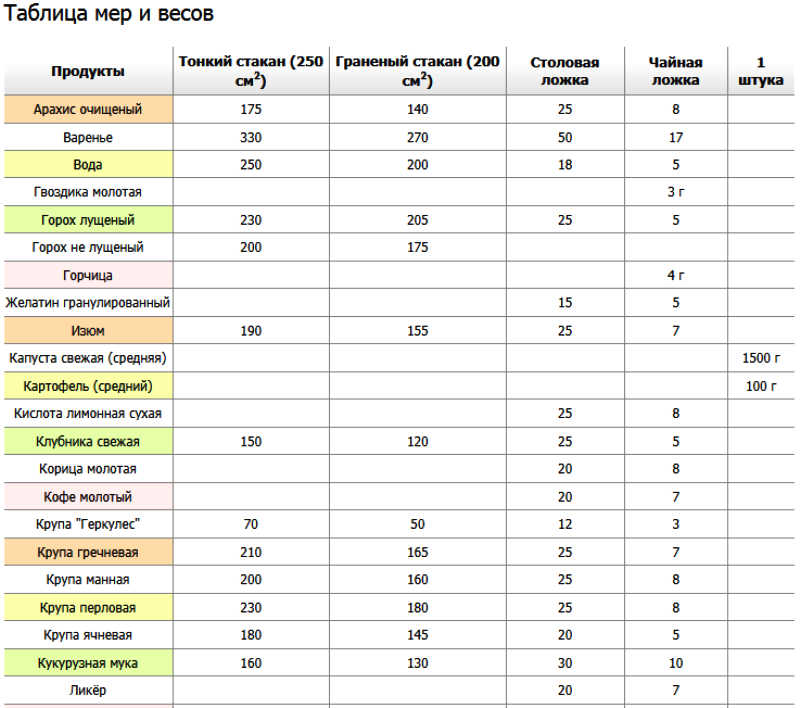
Many novice housewives in the preparation of food are guided by the data specified in the recipe. Typically, the recipe indicates the number of grams or common measures - spoons, glasses. If you have no scales in the kitchen, do not be discouraged, we will help you transfer grams into glasses and spoons.
1/2, 1/3, 2/3, 1/4, 3/4, 1/5, 2/5 cup flour, sugar - this is how many grams or tablespoons: photo
Do not think that the usual faceted glass contains the same amount of grams of flour and sugar. The density of these substances is different, and despite the same volume of 250 ml, the glass contains different weight of flour and sugar.
The amount of flour and sugar in spoons and glasses:
- Flour. In the usual faceting glass, there are approximately 160 g of wheat sifted flour. Accordingly, half a glass is 80 g, 1/3 - 53 g, 2/3 - 106 g, ¼ - 40 g, ¾ - 120 g, a fifth of a glass of 32 g, and 2/5 - 64 g. In a tablespoon of flour - 30 g.
- Sugar. This product is slightly heavier than flour, so the glass contains 230 g of sugar. Therefore, in half a glass of 115 g, in a third - 77 g, in 2/3 approximately 150 g, and in a quarter 57 g, ¾ - 173 g, a fifth part of the capacity is 46 g, 2/5 is 92 g in a dining spoon of a sugar sand 25 g.
1/2, 1/3, 2/3, 1/4, 3/4, 1/5, 2/5 cup of milk, sour cream - this is how many grams or tablespoons: photo
Milk is not as thick as sour cream, but its density is much higher. Therefore, in the usual faceted glass, there are a different mass of these dairy products.
The content of milk and sour cream in different kitchen utensils:
- Milk. One glass contains 250 g of milk, therefore, in half the capacity of 125 g, in the third part 83 g, in a quarter of a glass of 63 g. In ¾ - 180 g, in the fifth of the glass 30 g, and in 2/5 - 60 g. This in the tablespoon contains 13 g.
- Sour cream. In a glass of sour cream, 210 g of the product fitting. Therefore, in half of the capacity of 105 g, in the third part - 70 g of the product, in a quarter of a glass of 52 g. In ¾ it contains 158 g, in the fifth part 42 g, and in 2/5 84 g. In the tablespoon contains 25 g of the product.

1/2, 1/3, 2/3, 1/4, 3/4, 1/5, 2/5 cup of water - this is how many grams or tablespoons: photo
Water is a universal and most common product that is used in the preparation of dishes. It is added during cooking and extinguishing. Also on the water, lean dough is kneaded.
In the glass, it impresses 250 g of water, if it is added to the top. If according to the border, then 200 g, respectively, in half a glass of 125 g, and a third of 83 g, a quarter of a glass of 62 g, and in ¾ 180 g, in the fifth of 30 g, and in 2/5 - 60 g in the dining room a spoon contains 13 g of substance.

1/2, 1/3, 2/3, 1/4, 3/4, 1/5, 2/5 cup of vegetable oil - this is how many grams or tablespoons: photo
Vegetable oil is the most common substance used for frying. In a glass, it impresses 200 g of this liquid. Despite the apparent density and viscosity, in a glass of vegetable oil is less than water.
Vegetable oil measures in spoons and in a glass:
- Half a glass contains 100 g of a product
- In the third part 67 g, and in 2/3 - 135 g
- In a quarter of a container 50 g, and in ¾ 150 g
- The fifth part contains 40 g, and in 2/5 - 80 g
- 17 g of liquid in the tablespoon

1/2, 1/3, 2/3, 1/4, 3/4, 1/5, 2/5 cup of walnuts - this is how many grams or tablespoons: photo
The number of grams of walnuts will vary depending on whether the half is or pieces. Of course, nuts in pieces with the same volume will weigh more than the product in halves. Most often, chopped nuts are used in the recipes, and we will consider their measures.
The content of nuts in spoons and glasses:
- The glass contains 170 g of pieces of nuts, so half will be 85 g
- A third of a glass will fit 57 g, and in 2/3 - 115 g
- In a quarter of the container you can measure 43 g, and in ¾ - 158 g
- The fifth part of the glass contains 34 g, and in 2/5 - 68 g
- A tablespoon you can measure 11 g

How to measure 100, 200 grams of flour, sugar, rice without scales with a glass?
If you are not acquired by kitchen weights, do not be discouraged. Products such as flour, rice and sugar can be measured without scales using glasses and spoons.
Ways to measure the specified weight of products with glasses:
- Flour. The glass contains 160 g, and in a spoon of 30 g, so pour a glass without a slide and remove two tablespoons of the product. So, you will get 100 g. Therefore, to measure 200 g, you will have to repeat the manipulation twice.
- Sugar. In a glass of about 230 g of sugar, so to take 200 g of the product, you need to remove a spoon with a slide from a glass. To measure 100 g, you need to take a half of the faceted cup and select a spoon without a hill.
- Rice. The glass contains 220 g of cereals, so in order to measure 100 g, you need to take a little less than half a glass of product. To dial 200 g, fill the container to the edges and select a tablespoon of cereals.

As you can see, measuring products using kitchen utensils is very simple, for this it is not necessary to purchase scales.
Video: Ways to measure products with glasses and spoons