
Description of varieties and species of chrysanthemums, planting, planting time.
Content
- What does Chrysanthemum look like?
- Varieties and types of chrysanthemums: names, description, photo
- Video: Chrysanthemums: Description and care
- Chrysanthemums of the flower
- Chrysanthemum indoor in a pot: Care at home
- Video: grow chrysanthemums at home
- Chrysanthemum in the pot will wither, what to do?
- Chrysanthemum in the pot has faded, what to do?
- Chrysanthemum Anno -year cultivation from seeds, landing and care
- Video: Propagation of chrysanthemums
- Chrysanthemum is a garden perennial: when to plant in open ground in the spring, when to transplant?
- How to root and propagate chrysanthemum cuttings from a bouquet at home?
- The division of the bush of chrysanthemum
- How to pinch chrysanthemum?
- How to feed chrysanthemums in the spring?
- Care for chrysanthemums in the fall preparation for winter
- Video: Chrysanthemum storage in cold weather
- Illness chrysanthemum
- Why don't chrysanthemums bloom in the garden?
- How to withdraw thrips and aphids in chrysanthemum?
- Video: Growing chrysanthemums in the garden
When the first autumn days come and almost all plants stop flowering, the time of the reign of chrysanthemums comes. Let's learn more about this beautiful flower
What does Chrysanthemum look like?
Chrysanthemum got its name because of the resemblance to the sun, translated from Greek, it sounds-"" sun flower", And in Latin sounds like "Gold -color". In Europe, this beauty was brought from the Far East, where she was treated with special reverence, considering the flower of emperors. In the New and Old World, he also became a favorite decoration of the autumn garden.
Chrysanthemum - This is a herbaceous decorative plant up to 1.5 meters high, it can grow both on the street and in the pot of the house. Inflorescences are a small or large basket of all kinds of shades. Propagation is carried out by seeds or cuttings.

Thanks to the work of breeders today, there are many species and forms of chrysanthemums. This plant often becomes the subject of collecting gardeners.
Varieties and types of chrysanthemums: names, description, photo
There are a great many varieties of chrysanthemums and they are classified according to different parameters. In this article we will dwell on the main types of classifications.
On the life cycle:
- Annual (Flamenstal, Frosh Mishung, Stern ten orens, cockalde, tetra comets) - differ in cold resistance, you can sow right into the ground, are quite unpretentious. Bloom for a very long time, until frost
- Perennial (Florida, Ch. X Koreanum Makai, Goldball - are divided into greenhouse, which are designed for cutting, and Korean varieties (usually borders), characterized by abundant flowering and good resistance to adverse conditions

According to flowering periods, varieties are distinguished:
- Early (Hands, Deliana) - in September
- Middle (Anastasia Lil, Froggi, Orange) - in October
- Late (Rivardi, Larisa) - in November
By resistance to cold:
- cold -resistant (Korean chrysanthemum, susan) - stable even to the first snow
- for soft climate (fantasy) - may not have time to bloom until the first frosts are grown in the southern latitudes
It must be said that low non -acute varieties are more resistant to cold. The larger the plant, the less frost -resistant it is
In terms of inflorescences:
- Large-flowered (Anastasia Green, Zemble Lilak, Tom Pierce)-the diameter of the flower hat reaches up to 20-25 cm, has a hemispherical shape, the stems are high. Grown for cutting. As a rule, they cannot stand wintering on the street
- Midnights (golden rune, champagne spray, pink chamomile)-inflorescence up to 8-10 cm, grown in the garden and on balconies

In the shape of the inflorescence:
- Simple (Beautiful Lady, Amazon, Andre Rose, Baltika) - the middle of the inflorescence is open, framed by one or two rows of petals. It looks like a big chamomile
- Terry (Zlata Prague, Gazella, Trezor) - numerous rows of petals cover the flower middle completely

Video: Chrysanthemums: Description and care
Chrysanthemums of the flower
When it comes to the symbolism of this flower, the traditions of the Far East are taken as a basis, from where it was imported.
- in Japan This plant is considered a symbol of the sun, and its image is present even on the country's imperial press, foreign passports. Denotes a rapid course of life and its fragility. In addition, it is a symbol of happiness and long years
- in China Chrysanthemum is a flower of fidelity, as well as high position and honor. Previously, the image of the flower was present only on imperial clothes
- in Vietnam This plant speaks of the purity of thoughts and clarity of the mind
In addition, in the east of chrysanthemum to this day it is considered a magic flower that has magical power:
- washing dew, collected from the petals, prolongs youth and retains beauty
- adding petals in Saka gives longevity
- wiping the fabric into which the flowers were wrapped overnight, prevents diseases
- bridal bouquet white color gives the bride the heavenly blessing
Having spread all over the world and gaining popularity, in different countries the plant has gained its meaning. Depending on the coloring, a bouquet of chrysanthemums can mean:
- white - tenderness, innocence, sincerity
- yellow - reverent love, trust, nobility
- red - passion
- pink - naivety of youthful love
- blue - fun and joy

But do not forget that in some regions of Europe chrysanthemum are a symbol of mourning and sorrow. Therefore, you need to be more careful with the choice of the bouquet.
Chrysanthemum indoor in a pot: Care at home
Thanks to the efforts of chrysanthemum breeders, we can delight us both in the garden and in pots on the windows. Suitable for this, low -growing varieties bred specifically for closed soil:
- silky -captive (Chinese) (Chrysanthemum X Morifolium)
- indian (Chrysanthemum x Indicum L.)
- korean (Chrysanthemum X Koreanum)
Chrysanthemum is a plant that begins to bloom when daylight hours are reduced to 8 - 10 hours. Flowering can occur during periods:
- march, April
- september - November

Caring for chrysanthemums is not as difficult as it seems at first glance. You just need to take into account the basic features of these colors, which:
- are photophilous. Do not keep the flower in the shade, but remember that the direct sunlight for chrysanthemums are destructive. The western or eastern sides of the apartment is the best place for these plants
- love fresh air. If possible, grow chrysanthemums on the balcony or loggia. If they grow in the room, ventilate the room more often
- they prefer coolness.Try that the air temperature is not too high. Share your flowers on sunny days
- molom -lovingbut do not need frequent watering. Water enough once every 3-4 days after the top layer of soil dries, preferably in the evening. But do not allow and drying the earth in a pot
- love spraying.Periodically refresh the flowering flower. But if you grow it on the balcony in the fall, then do not spray. Air humidity is sufficient
- need regular top dressing.For abundant flowering, feed fertilizers with phosphorus. It is also good to use bird droppings for this purpose
- timely removal of faded flowers is necessary. So that the plant does not lose its decorativeness, regularly break off the dried inflorescences and stems
- require a periodic transplant. Plant the young plant once a year, adult - every 2 years. Do this in early spring, when the growing season begins
Correct temperature regime - the key to the successful cultivation of room chrysanthemum and its abundant flowering. According to gardeners, such temperatures above zero are considered optimal:
- in the fall-15-18 ° C
- in winter-0-7 ° C
- spring-11-17 ° C
- in summer - up to 23 ° C
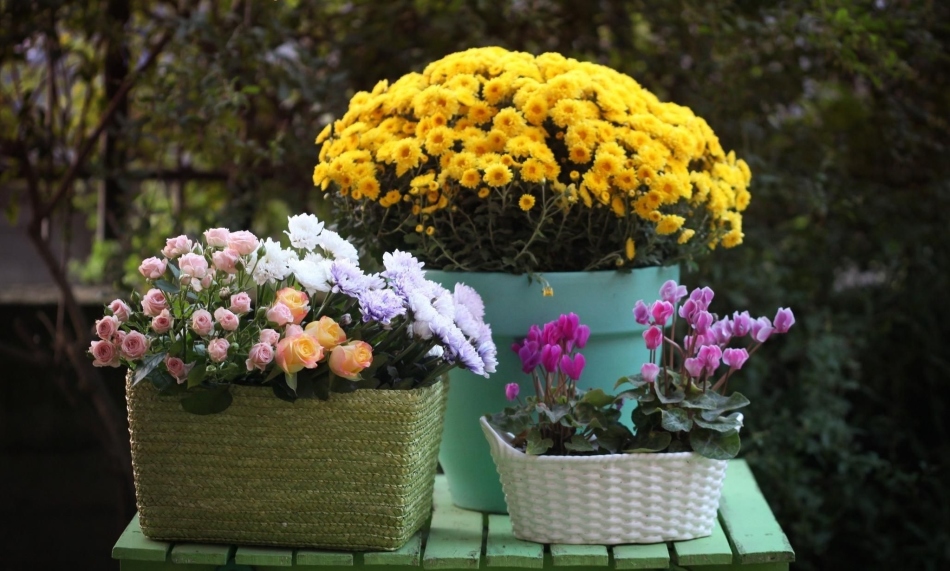
Compliance with the listed simple rules will certainly delight you with lush flowering of your favorite "sunny" colors.
Video: grow chrysanthemums at home
Chrysanthemum in the pot will wither, what to do?
Often you can hear that pottering chrysanthemums begin to fade a few days after the acquisition. There may be several reasons:
- high air temperature. Chrysanthemum loves coolness. When the temperature rises, the leaves begin to dry, the buds fall
- excess watering.It happens that the owners literally “love” their pet and arrange a whole swamp in a pot, from which the earth acidifies, and the roots begin to rot
- incorrect maintenance in the store. Flower stores of plants are often contained in peat and are supported by special nutritional liquids. After buying without receiving such substances, the flower begins to “starve” and wither
- the presence of a disease or pests. From too dry air per flower can attack a spider mite or other parasites. In addition, perhaps the plant was under the disease before
Carefully watch your plant and try to eliminate the possible reason for its wilting:
- remove the pot from the battery of central heating or hot windowsill
- reduce watering
- transplant the flower into a new mail, trying not to damage the roots
- treat with special products against pests and diseases

If these actions did not lead to a positive result, do not rush to throw away the chrysanthemum. Cut its stems and send it to the winter in a cool darkened place. Perhaps in the spring she will let young shoots and will delight you.
Chrysanthemum in the pot has faded, what to do?
Many believe that the flowering chrysanthemum in the pot is a “one -time” flower, a kind of bouquet that, after faded, has forever lost its decorativeness. If the plant after wilting its inflorescences, to properly care for, it will please you more than once.
The main thing is that you need to know the basic rules for the content of chrysanthemum after its flowering. First you need to determine where you plan to keep the plant in the future:
- in open ground
- home in a pot
In the first case, everything is simple: in the spring, just transfer your flower to the garden for the summer. If the transplantation into open ground is impossible, then organize the period of “hibernation” with your chrysanthemum. This is done like this:
- after wilting the flowers, cut all the stems just above the first kidneyleaving only young shoots up to 10 cm long
- transfer the pot to the cool room (basement, loggia, cellar). It is desirable that it is dark there, you can cover with a film or paper
- provide the temperature from 0 to 7 ° C
- water very rarely, avoiding drying the earth
- in the spring, when young shoots begin to appear, transfer the flower to new soil
- in time, carry out pinching shoots to form a beautiful compact bush

Chrysanthemum Anno -year cultivation from seeds, landing and care
Nowadays, annual chrysanthemums are gaining particular popularity. They bloom abundantly until late autumn, decorative and diverse. There are practically no difficulties to grow their seeds. Sowing is carried out by two methods:
Right to the flowerbed (The beginning of flowering is from mid -August):
- suitable for almost all types of chrysanthemums
- sowing period - from mid -May
- dig the holes between which the distance is about 35 cm
- pour
- throw the seeds there (2 pcs.)
- sprinkle with the soil
- cover for heat with a film
- after shoots appear, remove the film
- after 7 days, make fertilizers
- when the plants are about 7 - 12 cm high, thin them
Through growing seedlings (begin to bloom earlier):
- sowing period - end of February or early March
- pour the drainage into the not very deep boxes
- pour the soil mixture, including humus and peat
- moisten slightly
- distribute the seeds evenly
- sprinkle up to 1 cm on top with soil on top
- drink slightly with water
- cover with glass or film
- put in a place where the temperature is not lower than 24 degrees
- periodically ventilate the boxes
- after 10 - 14 days, remove the film
- put the boxes in a bright place
- when 4 - 6 leaflets appear, harm
- in May, land on a flowerbed

Remember that annual chrysanthemums love bright places, loamy soil and timely top dressing.
Video: Propagation of chrysanthemums
Chrysanthemum is a garden perennial: when to plant in open ground in the spring, when to transplant?
The cultivation of perennial varieties of chrysanthemums has its own characteristics, the teaching of which guarantees abundant and spectacular flowering. Young plants need to be planted like this:
- it is preferable to plant in the garden through seedlings
- the period of landing is the end of May or early June, when the probability of night frosts passes
- select a sunny, preferably elevated place for planting
- dig the holes 25 cm from each other in a checkerboard pattern so that the plants receive the light of the sun equally and do not obscure each other
- put sand drainage on the bottom of the hole, peat with lime, humus
- pour water
- place seedlings, deepening the root neck no more than 2 cm
- sprinkle with earth
- pour
- if the seedlings are high, tie it to the pegs
- mulch on top with needles or leaf mixture
- after 2 weeks, do the first top dressing

Perennial chrysanthemum can live in one place for no more than 5 years. Then her flowers are smaller, and the plant loses its decorativeness. Therefore, it is advisable to transplant this flower every three years in May.
How to root and propagate chrysanthemum cuttings from a bouquet at home?
How often, having received a chic bouquet of chrysanthemums as a gift, we are sorry to part with him after his wilting. It turns out that you can grow flowers from the bouquet you attracted. And it is not difficult to do this at all:
- wait for when the flower will foam
- clean the stem of leaves and inflorescences
- cut the top
- put in fresh water
- after the roots appear, plant the cuttings in neutral or slightly acidic soil (either in a pot or in open ground) to a depth of not more than 5 cm
- care as usual

The method of growing you like the varieties from donated bouquets has long been known to gardeners and is popular in breeding chrysanthemums.
The division of the bush of chrysanthemum
Controls are recommended to periodically separate large bushes. This must be done when the plant is 3 years old. In addition, the division of the bush is one of the ways of propagation of perennial chrysanthemums. This is done like this:
- dig a bush and shake off from excessive land
- remove the old stem stems
- separate the young shoots
- cut them if they are too long
- plant them in different holes at a distance 25 cm from each other
The process can be carried out in the spring after a threat of frosts, or in August. In this case, take care of the correct wintering of the plant.
How to pinch chrysanthemum?
In order for Chrysanthemum to form a beautiful thick bush and blooms magnificently, it is necessary to carry out regular pruning and pinching of shoots. This applies to both garden species and pots. What to consider:
- make the first pinch when the central stem grows to 10 cm
- second - when the side shoots reach 10 cm
- subsequent pinching, taking into account the features of the type and shape of the plant
- the last-2-2.5 months before flowering
- remove young stepsons in time so that before the flowering in the outlet there are no more than 5 - 6 stems
The number of jokes Chrysanthemum depends from the timing of flowering:
- early varieties - one or two
- medium and late varieties - from 3 times

In addition, for intense and lush flowering:
- to obtain a large flower, remove the side buds as soon as they appear
- in small -flowered varieties, to stimulate flowering of lateral shoots, remove the central bud
- regularly remove wilted buds to extend flowering
How to feed chrysanthemums in the spring?
For the successful cultivation of chrysanthemums, it is necessary to feed plants in time. Feeding plants in the spring is the main condition for the development of flowers. It must be carried out correctly:
- first fertilize with additives with the content nitrogen In order for the plant to increase the green mass. The lack of nitrogen will lead to the fact that the leaves will lose green, the stems will be weak
- after the active period of the growing season and the formation of an adult bush for the establishment of buds and subsequent flowering, add potassium-phosphorus Fertilizers
In addition, take into account the fact that different types of chrysanthemums need different ratio of nutrients:
- for small -colored ones it is more suitable potassium-an isolate Composition with a high potassium content in the early growth period
- for large -flowered high during this period you need more nitrogenso that the stems grow powerful and strong
- phosphorus all varieties are necessary, because it is he who provides abundant and bright flowering

The frequency of entry - once a week. And if the soil is poor, then every 4 days. Do not forget about the main rule of gardeners - it is better to undergo a plant than to overfeed.
Care for chrysanthemums in the fall preparation for winter
The preparation of chrysanthemums for wintering depends on the cold resistance and the place where it will spend the winter:
In room (It is recommended if in your region severe frosts or plants are designed for growing in a soft climate):
- after the onset of the first frosts, dig the bush along with the lump of the earth
- plant the plant in a suitable container or even dense bag
- sprinkle with wet soil
- place the flower in the basement or cellar, where it is cool, but the temperature does not drop below zero
- water no more than twice a month
In open ground (Suitable only for frost -resistant chrysanthemums):
- help around the bush so that there are no recesses in which precipitation may accumulate
- on the sides of the plant, install boards on which you can put covering material. This will provide simultaneous ventilation and protection against rains and snow
- after the onset of the first frosts, pour foliage, branches, spruce branches on top

Regardless of where your plant will winter, before sending to the “rest”, be sure to follow the following actions:
- regularly inspect the plants for diseases or pests. Only healthy and strong flowers can successfully transfer winter
- in early September, feed chrysanthemums for the last time by fertilizer with content phosphorus and potassium. In no case do not make nitrogen. This can lead to an increase in green mass and further death of the plant
- in the first half of November, cut the stems before frost, leaving about 10 cm from the roots
Proper preparation for the rest period will allow the colors to delight your garden for many years.
Video: Chrysanthemum storage in cold weather
Illness chrysanthemum
Like any decorative plant, chrysanthemums can be subjected to diseases that are divided into:
Viral infections, the source of which can be infected planting material or insects:
- ring spotting - yellow spots appear on the leaves, the leaves become lethargic
- dwarf - growth is delayed, the flowers become small
- brightness - inflorescences are deformed, losing their shade
- mosaic - mosaic stains appear on the leaves
Unfortunately, in these cases it is impossible to save plants, they are simply destroyed.
Fungal infections, the source of which, as a rule, is excessive moisture due to frequent watering or heavy rains:
- vertikillic wilting - the leaves are yellowing from below, and the stem fades
- powder - the plant is completely covered with white coating
- rust - red spots are formed, the leaves turn yellow
- gray rot - Plants are covered with a gray coating and begins to rot
- septoriosis - characterized by the appearance of yellowish spots

Various drugs (colloidal sulfur, copper chloride, burgundy fluid) are used for treatment.
Do not forget that the disease in flowers is easier to prevent:
- provide moderate watering
- do not thicken the landings
- carry out autumn digging flower beds
- remove the remaining plants
- destroy sick plants in a timely manner
Why don't chrysanthemums bloom in the garden?
Chrysanthemums are grown for the sake of spectacular bright colors. And it is very disappointing if the flowering in the plant does not occur or is late. There may be several reasons:
- lack of light, chrysanthemums bloom well only in open sunny areas
- after wintering, the bush was taken late for germination. This must be done in early March
- the uterine plant is not rejuvenated on time. Before planting the bush in the ground, be sure to hurt it
- irregular top dressing -do not forget to make fertilizers in a timely manner during the period of active extension of green mass, laying buds, flowering
- drying of the soil -the soil around the plant should always be slightly wet
- late varieties, The flowering period of which falls in November or December. It happens that the plant simply does not have time to cover with flowers before the arrival of severe frosts
How to withdraw thrips and aphids in chrysanthemum?
Trips and aphids - peststhat can impress the plants, including chrysanthemum. The flowers then lose their decorativeness, the leaves turn yellow and dry. You can deal with these insects using special chemicals
For use in the house:
- "Fitoverm"
- "Aktellik"
For greenhouses or garden:
- "Vertimek"
- "Agravertin"
- "Spark"
- "Aktara"

Carry out the processing of affected plants 2-3 times with a frequency of 7-8 days to get rid of the hatched insects. In addition, wipe the leaves with soap solution.
You can also use folk methods:
- swat the stems of marigolds with half the container, share water and leave for two days
- pour the blooming celandine with water and insist for a day
- pour the peel of citrus fruits (200 g) with boiling water (1 l). Insist 3 days
- dilute a little shampoo from fleas in water
- make an infusion of tobacco and water
- place next to Chrysanthemum Pelargonium. It is believed that it scares off insects
If none of the above means helps, unfortunately, you need to get rid of the flower in order to avoid infection of other plants.
Video: Growing chrysanthemums in the garden